
It is less common in the writing test, but sometimes you will get an IELTS process diagram to describe.
This should follow the same format as any task 1:
- Introduce the diagram
- Give an overview of the main point/s
- Give the detail
What is an IELTS Process Diagram?
To begin, look at this question:
You should spend about 20 minutes on this task.
The diagram illustrates the process that is used to manufacture bricks for the building industry.
Summarise the information by selecting and reporting the main features and make comparisons where relevant.
Write at least 150 words.
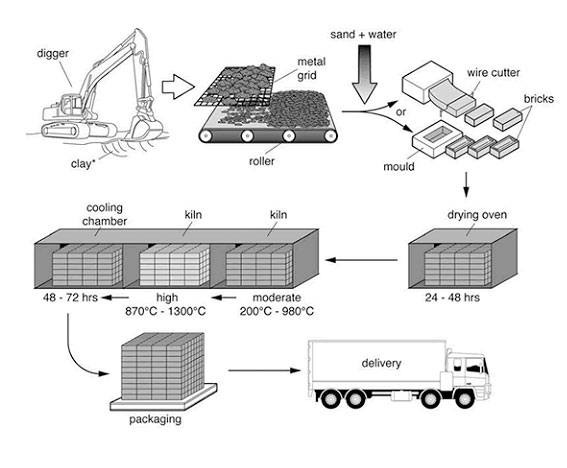
IELTS Process Diagram – Brick Making
To begin, the clay used to make the bricks is dug up from the ground by a large digger. This clay is then placed onto a metal grid, which is used to break up the clay into smaller pieces. A roller assists in this process.
Following this, sand and water are added to the clay, and this mixture is turned into two differing types of brick by either placing it into a mould or using a wire cutter. Next, these bricks are placed in an oven to dry for 24 – 48 hours.
In the subsequent stage, the bricks go through a heating and cooling process. They are heated in a kiln at a moderate and then a high temperature (ranging from 200c to 1300c), followed by a cooling process in a chamber for 2 – 3 days. Finally, the bricks are packed and delivered to their destinations.
These are some common IELTS process diagram connectors:
To begin
Following this
Next
Then
After
After that
Before**
Subsequently
Finally
** If you use before, this means that you will be mentioning a later stage before an earlier stage, so you need to use it carefully. If you can use it properly though, it will get noticed.
Here is an example using stages four and five:
Before being dried in the oven, the mixture is turned into bricks by either placing it into a mould or using a wire cutter.
2) The Passive
When we describe an IELTS process that involves humans (a man-made process as opposed to a natural one), the focus is on the activities, NOT the person doing them.
When this is the case, we use the passive voice, not the active. For a natural process, such as the life-cycle of a frog, we use active as there is not a person doing the activity in the diagram.
This is a brief explanation of how to use the passive voice, but if you are new or unsure about using it, you should do some further study and practice.
Most sentences use this structure:
- Subject + Verb + Object
- A large digger digs up the clay in the ground.
In the active voice (as above), the digger is doing the verb i.e. the digger is doing the digging.
When we use the passive voice, we make the object (the clay) the subject, and make the subject (the digger) the object. We also add in the verb ‘to be’ and the past participle (or Verb 3).
- (S) The clay in the ground (V) is dug up (O) by the digger.
So throughout most of your description for your IELTS process diagram, you should be using the passive voice.
This is difficult as some verbs cannot take the passive. For example, ‘to go’ cannot be passive, so it is kept in the active voice:
- …the bricks go through a heating and cooling process.
This is why you need to make sure you practice the passive so you know exactly how to use it.
Also, as you will see from the description, it is more usual to to comment on who or what is doing the action so the ‘by….” phrase is excluded.
Here is the same example description with uses of the passive highlighted:
The Passive Voice:
To begin, the clay (which) is used to make the bricks is dug up from the ground by a large digger. This clay is then placed onto a metal grid, onto a metal grid, which is used to break up the clay into smaller pieces. A roller assists in this process.
Following this, sand and water are added to the clay, and this mixture is turned into bricks by either placing it into a mould or using a wire cutter. Next, these bricks are placed in an oven to dry for 24 – 48 hours.
In the subsequent stage, the bricks go through a heating and cooling process. They are heated in a kiln at a moderate and then a high temperature (ranging from 200c to 1300c), followed by a cooling process in a chamber for 2 – 3 days. Finally, the bricks are packed and delivered to their destinations.
Varying your Language
Sometimes it may be appropriate just to use the same language that you are given in the IELTS process diagram to describe it, but you should try to vary it.
You may be able to use nouns from the diagram as your verbs. For example, the noun packaging in stage seven becomes:
Finally, the bricks are packed…